

History of Vietnam lacquer art
Among Vietnam’s eight nationally treasured paintings, six are crafted with lacquer – a testament to this medium’s cultural importance. Vietnamese lacquer art is not simply a painting technique, it is a convergence of meticulous craftsmanship, Eastern aesthetics, and contemporary creative spirit. Over generations, artists have both preserved and innovated lacquer painting, making it a defining hallmark of Vietnamese fine arts and a vibrant part of today’s contemporary art scene.
What is lacquer art?
The term 'lacquer art' encapsulates the two essential processes at its core: layering (lacquering) and polishing. Originating from traditional coating crafts, Vietnamese artisans transformed lacquer into an exceptional form of fine art. Renowned for its technical complexity and element of surprise, the true appearance of a lacquer painting is only revealed after the final polish,making each piece a unique artistic journey.
Gaining prominence in the 1930s, Vietnamese lacquer art soon became one of the nation’s most iconic contributions to world art. Pioneers such as Nguyen Gia Tri, Nguyen Sang, and Nguyen Tu Nghiem are among those who elevated this medium to an international stage.
Basic steps in creating a Vietnamese lacquer painting
- Sketching out the initial concept and composition.
- Enlarging the sketch and defining details.
- Applying the image to a wooden panel (voć), inlaying eggshell or mother-of-pearl, outlining, and adding color.
- Polishing the painting using water and sandpaper.
- Coating with clear lacquer and buffing for a glossy finish.
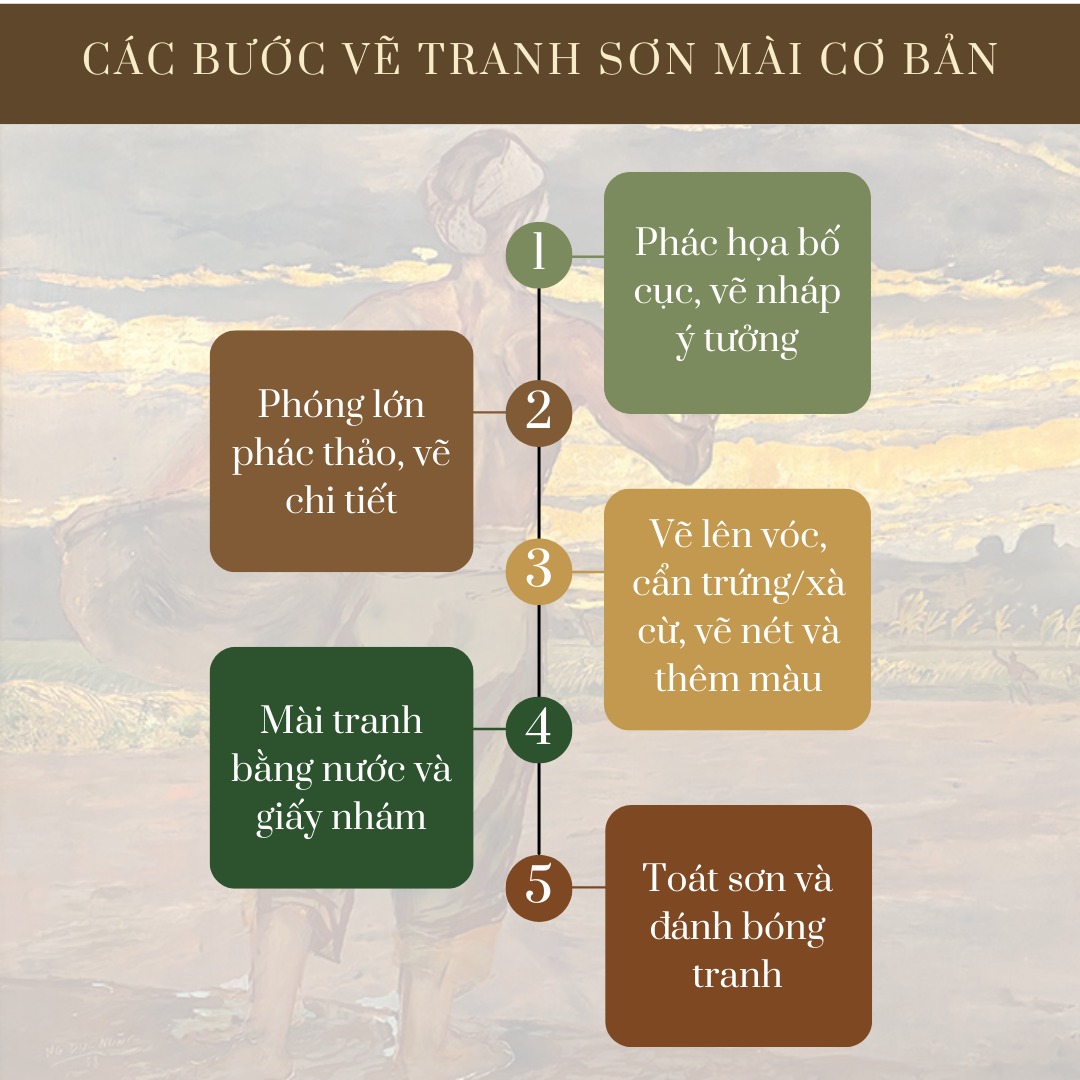 Basic steps of the lacquer painting process.
The art of Vietnamese lacquer lies in its cumulative process. Rather than one single layer, each painting is built up with multiple layers of lacquer, pigment, resin, gold or silver leaf, eggshell, mother-of-pearl, and other materials. Each layer is applied, dried, and then skillfully sanded to reveal intricate depths and textures. This multi-layered technique produces a visual depth that is difficult to achieve in other mediums.
Distinctive aesthetic features of Vietnamese lacquer art
What makes Vietnamese lacquer art so mesmerizing is, first and foremost, its color depth. Unlike the immediate brilliance of oil or acrylics, lacquer colors appear muted, resonant, and quietly radiant through overlapping layers. When deep reds, jet blacks, gold, silver, eggshell white, and chestnut browns are juxtaposed, the result is both timeless and sophisticated.
Another hallmark is lacquer’s subtle play of light. As the viewer moves or the ambient light shifts, the painting’s surface responds, revealing glimmers from gold, silver, mother-of-pearl, or translucent lacquer layers. This understated shimmer lends each piece a contemplative, serene quality with profound visual impact.
Vietnamese lacquer paintings are also celebrated for their craftsmanship and uniqueness. Every layer of sanding and polishing demands an artist’s experience and intuition,knowing when to reveal and when to preserve. Even small changes in pressure, timing, or lacquer thickness can alter the final outcome, ensuring that each work remains a singular creation, even within the same thematic series.
Lastly, Vietnamese lacquer art is deeply rooted in local culture. Popular themes draw from village life, festivals, lotus ponds, buffalo boys, ancient streets, family memories, and folklore. These subjects are not just depicted but infused into the solemn lacquer, evoking both intimacy and reverence in every piece.
Distinguish between lacquers
Lacquer painting has always been the pride of traditional Vietnamese art. Under the talented hands of artisans, the lacquer materials given by nature are transformed into colorful works.
Son ta is the soul of lacquer painting throughout the twentieth century, as a famous artist To Ngoc Van shared: “The noun lacquer (laque) is a new noun coined later to refer to a technique formerly called lacquer painting. Son Ta has completely transformed due to the art of polishing paint. Son Ta technique is similar to Chinese painting, dating back to the Han Dynasty.[…]
However, from 1931 onwards, thanks to the earnest research of a number of talented artists who abandoned oil painting to switch completely to lacquer, Son Ta was able to go beyond the confinement, boldly on the vast path of painting. , keep moving forward in strange directions. From the casket, the clog, it surpasses the precious framed painting, from a dependent means of painting objects, it becomes a unique means, a means that surpasses oil painting. Forgetting the past, I changed my name to Son Mai.”
However, along with its historical development, Vietnam has had access to many new artistic styles and materials. Lacquer is no exception to the integration process when Japanese paint becomes a familiar tool in lacquer painting. Many people think that Japanese paint now somewhat “overtakes” our paint. Regardless of the material, the artist always wishes to convey his perspective to the viewer. Therefore, we need to find a balance between preserving the cultural beauty of our country as well as receiving modernity from Japanese paint.
Japanese lacquer
Japanese lacquer is also a traditional material, but currently, artists use this material, which is understood as Japanese industrial paint. Japanese paint dries quickly and has properties suitable for countries with low humidity like ours. The limitation of natural paint is that it can easily cause side effects to the user (being “eaten by paint”). In addition, when using natural paint, the painting depends a lot on the weather. When the weather has high humidity, the paint dries faster. If the weather is dry (low humidity), the paint takes a long time to dry, so many current artists love Japanese lacquer.
But when using Japanese paint, to make the painting glossy, the artist often uses a layer of clear paint (cockroach wing paint) to cover the outside of the painting, but if the lacquer painting uses Japanese paint, just take a handful of messy hair and rub it on the painting, Or use damp hands (with a little sweat) to rub the painting, it will be very shiny.
Although it does not have the same depth over time as our paintings, Japanese lacquer has a variety of colors to create cheerful shades and a much more modern array of colors. Therefore, depending on the style and brushstrokes as well as the use of colors, each artist chooses his own materials.
Traditional lacquer
Although traditional lacquer does not have many special colors like Japanese lacquer, it requires a lot of meticulousness and materials to make, such as gold plating, silver plating, eggshells, oyster shells, and inorganic minerals. (for example, lipstick)… In particular, lacquer works using traditional materials will have certain depths over time, which can be loosely called “time color”. Furthermore, it is unique and cannot be repeated.
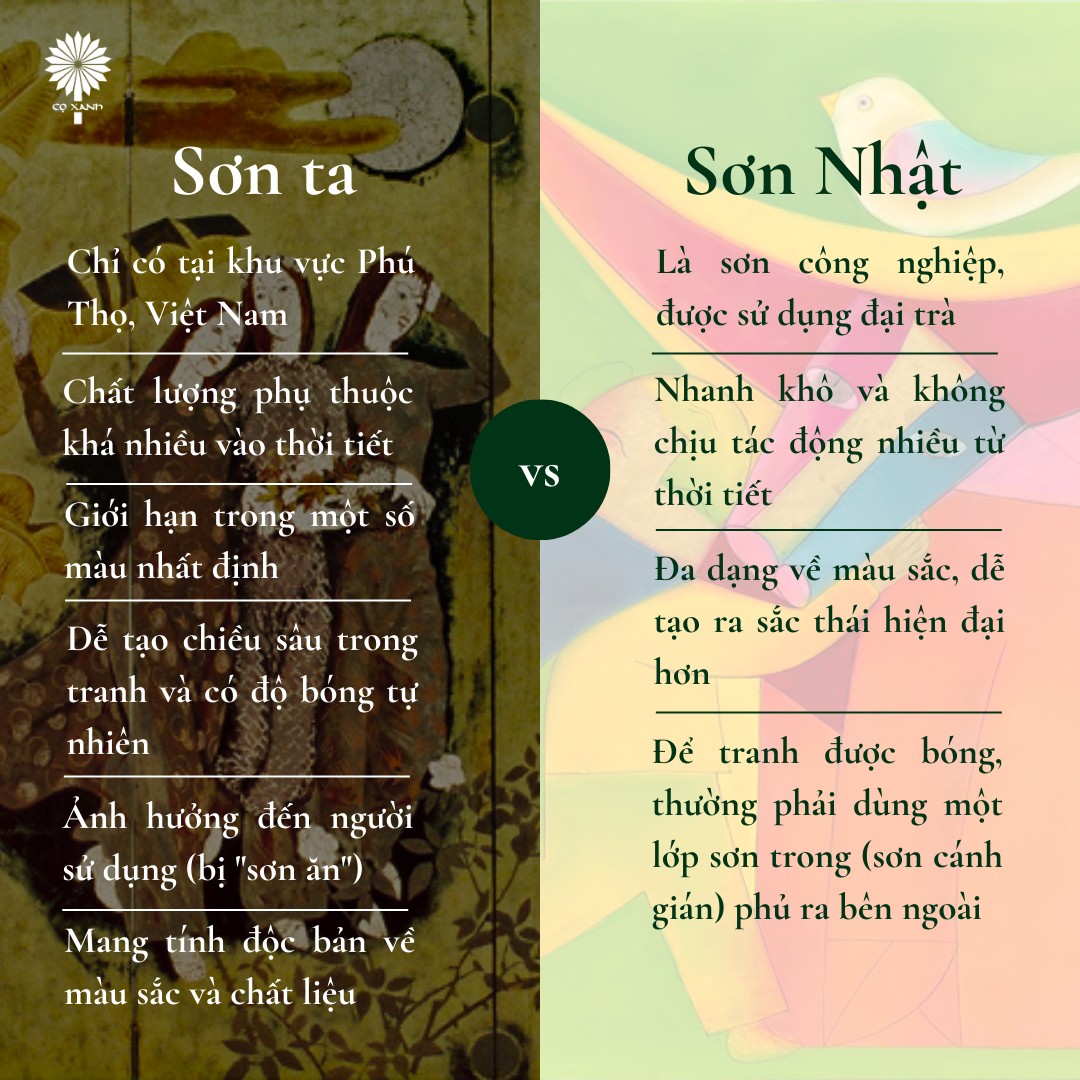 Comparison of Vietnamese lacquer and Japanese lacquer.
Some typical lacquer painters
Bang Nguyen
Born in Hanoi in 1958 and an alumnus of the University of Industrial Fine Arts (1983–1988), Bang Nguyen is a member of both the Hanoi Fine Arts Association and the Vietnam Fine Arts Association. With numerous awards and participation in both domestic and international exhibitions,including cultural events in France, Vietnam-Korea lacquer shows, and international lacquer exhibitions in Fuzhou, China,his impact is far-reaching.
Bang Nguyen’s evocative style draws heavily from rural life, folklore, and collective memory. His works reflect a reverence for everyday rhythms and the cultural atmosphere of traditional Vietnam.
Notable lacquer works by Bang Nguyen at Green Palm Gallery include:
- Golden Afternoon
- Spring Festival
- Daily Life
- Golden Moment
- Sisters
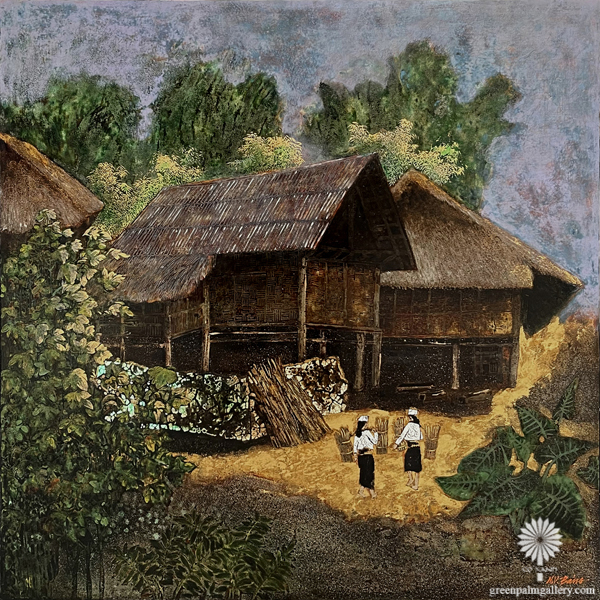
"Golden Afternoon," a lacquer painting by Bang Nguyen
Bui Huu Hung
Born in 1957 in Hanoi and trained at the Hanoi University of Fine Arts, Bui Huu Hung studied lacquer from 1975 in traditional workshops. A member of the Vietnam Fine Arts Association and, since 1996, the International Lacquer Artists Association, he has exhibited widely, from London and Paris to New York, Hong Kong, Singapore, Dubai, and Brussels.
Bui Huu Hung’s paintings are saturated with nostalgia. Deeply influenced by the traditional lacquer craft,ritual objects, altars, antique items,his canvases often depict princes, princesses, maidens, ancient artifacts, textiles, and historic patterns. The resulting imagery offers a tranquil, mystical, and memory-filled world.
At Green Palm Gallery, his representative works include:
- Blue Forest
- Green Memory
- Red Dream
- Still-Life III
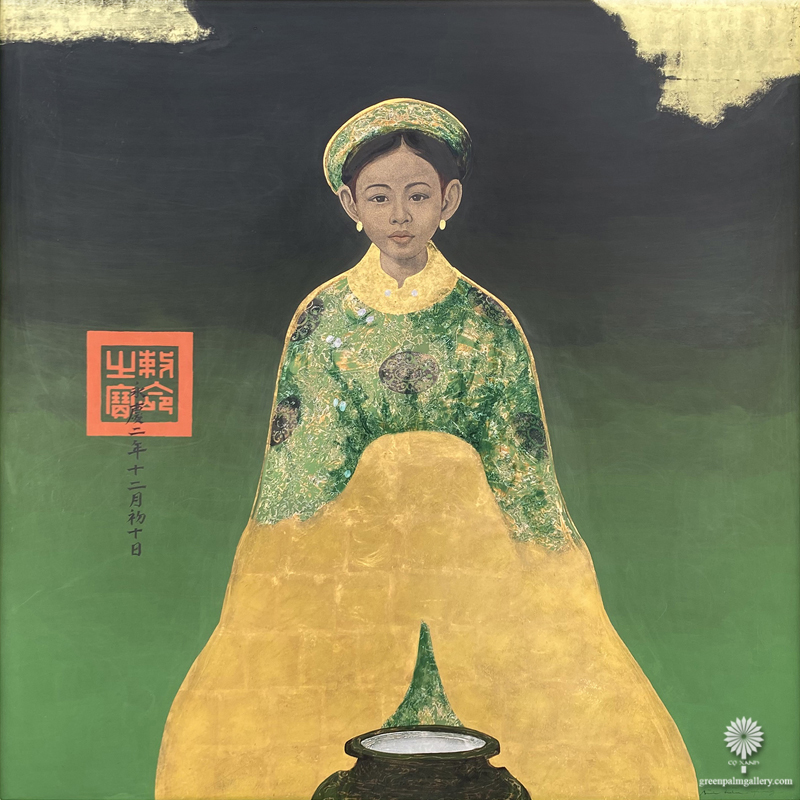
"Green Memories," a lacquer painting by Bui Huu Hung
Do Duc Khai
Born in 1969 in Hai Duong and a graduate of the Vietnam University of Fine Arts, Do Duc Khai is a member of the Vietnam Fine Arts Association, a leader in the Vietnam Natural Lacquer Artists Group, and formerly an expert at the association’s Central Office. His works have appeared in national and international exhibitions, including events in Russia, France, Germany, Italy, Korea, China, Taiwan, and major Asian lacquer shows.
Closely tied to traditional lacquer and Vietnamese nature, Do Duc Khai’s art features frequent motifs of lotus ponds, rural lakes, kingfishers, dragonflies, floating markets, and summer noons. These themes evoke a pure, tranquil world and highlight lacquer’s meditative strengths.
Noteworthy works of Do Duc Khai at Green Palm Gallery include:
- Kingfisher
- Village Pond
- Quiet Moment
- Lotus Pond
- Floating Market
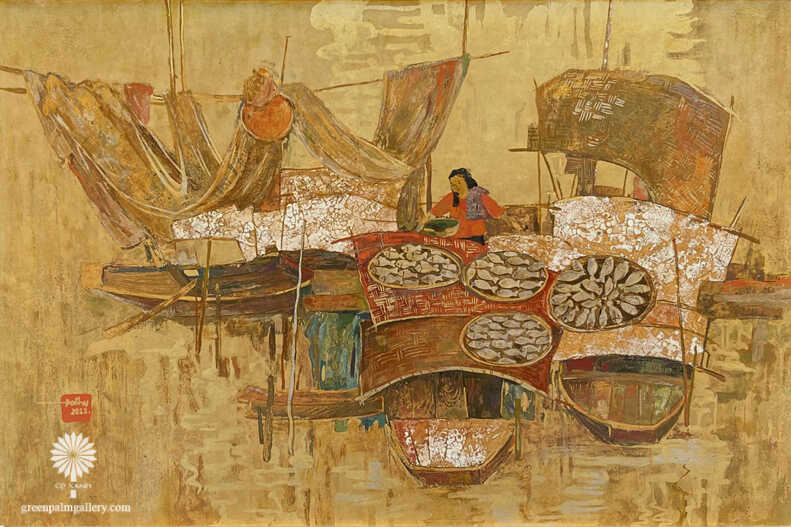
"Floating Market," a lacquer painting by Do Duc Khai.
Thanh Chuong
Born in 1949 in Bac Ninh, Nguyen Thanh Chuong studied at the Hanoi College of Fine Arts. He began painting at a young age, winning a gold medal at an international children’s art competition. After serving in the army and working as a staff artist for various publications, he amassed a distinguished exhibition and award record, with a 2001 piece chosen by the United Nations for an international stamp.
Thanh Chuong’s style is distinctly personal, often focusing on buffalo boys, bamboo flutes, oxen, moonscapes, and self-portraits. His use of bold colors and geometric abstraction embodies Vietnamese culture in a modern idiom.
At Green Palm Gallery, his important lacquer works include:
- Sunbathing
- Green Day
- Peaceful Village
- Children
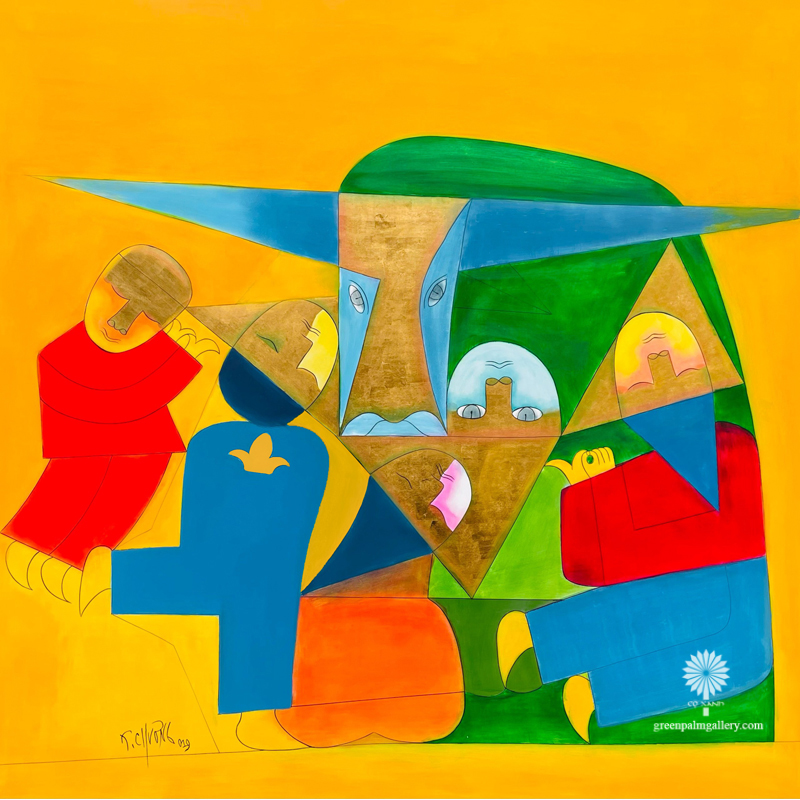
"Sunbathing", a lacquer painting by Thanh Chuong
For art lovers, discovering Vietnamese lacquer painting is not just about learning a technique,it is an entryway into the very heart of Vietnamese fine arts. At Green Palm Gallery, visitors can explore a diverse array of lacquer masterpieces by artists such as Bang Nguyen, Bui Huu Hung, Do Duc Khai, and Thanh Chuong, and experience first-hand the enduring beauty of this extraordinary medium in modern art.
|
GREEN PALM GALLERY Gallery in Ha Noi: 39 Hang Gai, Ha Noi, Viet Nam
Gallery in HCM City: 49 Mac Thi Buoi, HCM City, Viet Nam
|