

Dinh Cong Dat – Sculpture of a “crazy” person
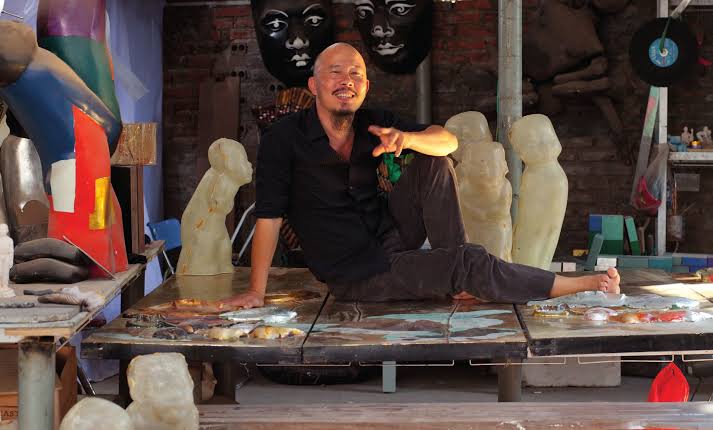
Dinh Cong Dat stands out as a remarkable figure in contemporary Vietnamese sculpture. His “eccentricity” isn’t mere quirkiness or affectation, but rather a way of seeing life through a perspective uniquely his own. From Negative faces and Grasshoppers to Ants,..., Dinh Cong Dat’s art invites viewers to discover beauty in the familiar, recasting ordinary subjects into works of unexpected artistic resonance.
Biography of Dinh Cong Dat
Born in Hanoi in 1966, Dinh Cong Dat is a member of the Vietnam Fine Arts Association and the Hanoi Literature and Arts Association. He is also part of the influential “Group of Five,” whose impact remains strong within the development of contemporary Vietnamese art.
Throughout his artistic career, Dinh Cong Dat has established himself not only as a sculptor but also as a creative force, expanding his practice into interior design, art projects, and organizing international art exhibitions. Rising to prominence during the late 1990s, he contributed to sculptural shifts in Vietnam by introducing new rhythms of form and embracing modern spatial languages.
His works have been showcased in numerous exhibitions both in Vietnam and internationally, including major cities like Hanoi, Ho Chi Minh City, London, Dubai, Paris, and Tokyo. Several of his pieces are housed in important collections, such as the Vietnam National Fine Arts Museum, the Singapore Art Museum, and the private collection of HRH The Duke of York.
What sets Dinh Cong Dat apart is his spirit of free, playful, and even mischievous creativity. He breaks free from the solemn conventions of classical sculpture, drawing inspiration from the simplicity of everyday life and infusing it with wit and originality.
The “crazy” spirit in Dinh Cong Dat’s sculpture
Dinh Cong Dat started his artistic path in a very natural way. His passion for sculpture was like something predestined by God, or what his mother said was “chosen by heaven”. After failing the university entrance exam, he went to work at a gemstone factory, then returned to study at the School of Fine Arts after discharge. He once told me not to ask an artist where he gets his inspiration from, because that’s restlessness, and if he doesn’t do it, it will be very difficult to live peacefully. That’s why, for the past 30 years, he has been diligently composing and marking his creativity not only in the Vietnamese art scene but also in the international market.
Using the reason that the majority will more easily forgive a “crazy” person than a “sane” person, Dinh Cong Dat with the name “Crazy” Dat gives viewers an “unusual” feeling when admiring the works. his works. This feeling comes from the fact that the audience cannot imagine that things that seem so familiar and natural, such as ants, grasshoppers, and children going to school, can bring such a wonderful visual impact. . His works are very popular when “taken straight from real life, without going through any literary or philosophical filters.” His statues always have a familiar image, seemingly without any deep meaning hidden behind them.
And that’s true.
He said that all of his works he brought straight from everyday life into the workshop, without putting too much emphasis on trying to convey any metaphorical meaning that would twist the viewer’s brain. The material is also extremely popular, without the need to be too “fancy” like paper, iron or composite plastic. An ant is an ant, what would it look like if it were bigger? Or watching his children carry their school bags to school, he immediately released the Schoolboy statue set to capture this moment.
Selected works by Dinh Cong Dat
Negative face
Among Dinh Cong Dat’s most notable works is the Negative Face series, exhibited at Green Palm Gallery and widely regarded as a career highlight.
In these pieces, he carves Buddha faces in both relief and hollowed form, evoking traditional Vietnamese temple carvings while imbuing them with modern spirit. This synthesis creates a unique tension: while grounded in local heritage, the works offer fresh, experimental perspectives for the contemporary viewer.
Lacquer is more than a surface finish; in Dinh Cong Dat’s hands, it adds sculptural depth. By combining fiberglass, a distinctly modern material, with traditional Vietnamese lacquer, he bridges past and present, crafting objects that resonate within both worlds. Negative Face stands as a vivid illustration of Dinh Cong Dat’s ability to weave tradition into forward-looking expressions.
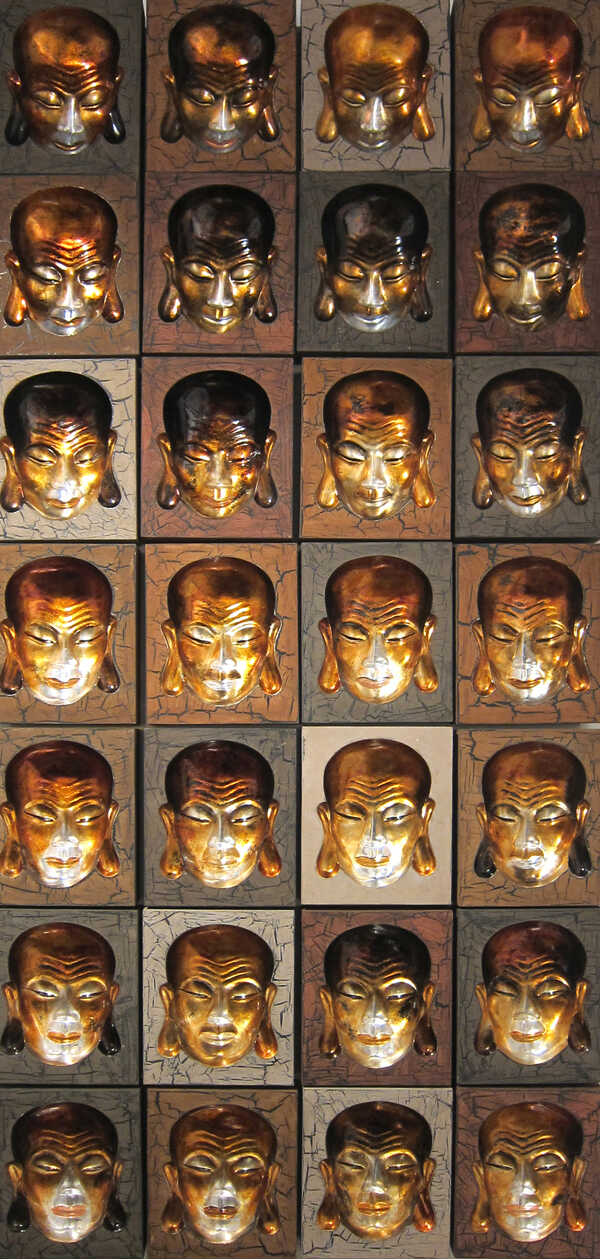
"Negative Face", a sculpture by Dinh Cong Dat.
Grasshopper
Grasshopper exemplifies Dinh Cong Dat’s capacity to transform the ordinary into the extraordinary.
Rooted in the rural Vietnamese countryside, the grasshopper is a familiar childhood memory. Yet, in Dinh Cong Dat’s sculpture, it becomes larger than life, its shape reconstructed, magnified, and given unique character. Beyond form, the materials also contribute to the work’s charm: plaster, newspaper, glue, and wire are skillfully assembled to create a bright, lively figure bursting with color and creativity.
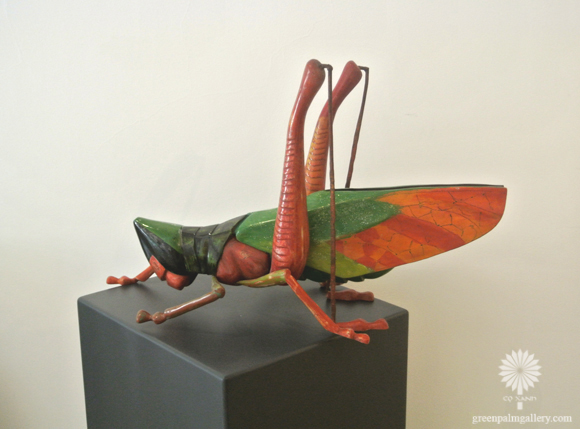 "Grasshopper", a sculpture by Dinh Cong Dat.
Siting Lady
Balancing his signature wit, Dinh Cong Dat also offers more contemplative works such as Siting Lady, The Monk.
In these pieces, viewers can sense a shift in mood, a respite from the playful handling of insects or childhood icons. Meditation encapsulates Buddhist influences, with pared-down forms and a meditative stillness that encourages introspection. Even so, Dinh Cong Dat’s modern sensibility remains, evident in his handling of surface and hue. Lacquer over fiberglass imparts a luminous, flexible finish - the past and the present, once again, in seamless dialogue.
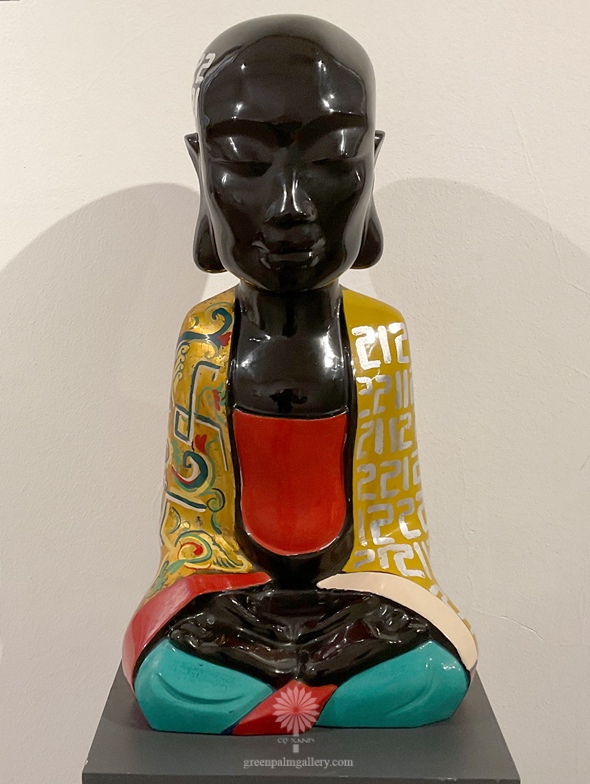 "Siting Lady" a sculpture showcasing the influence of Buddhist culture in Dinh Cong Dat's work
The meaning of Dinh Cong Dat’s work, in the end, is open, each viewer brings their own story and perspective, making the “crazy” appeal of his sculptures deeply personal. Visit Green Palm Gallery to experience Dinh Cong Dat’s singular vision and discover the remarkable in the everyday.
|
GREEN PALM GALLERY Gallery in Ha Noi: 39 Hang Gai, Ha Noi, Viet Nam
Gallery in HCM City: 49 Mac Thi Buoi, HCM City, Viet Nam
|